All’s Fair in Love, War and Peace


Talyn: A Novel of Korre by Holly Lisle

It had been awhile since I read a high fantasy novel when I came across this one in the Midtown Library.  No, it’s not one of those trashy romance fantasy novels, the material in there is not that graphic either so I’m guessing the cover is to sensationalize it.  The cover of the edition I had was mostly black and doesn’t look like much.

Lisle creates a vivid world for her characters to play in, ripe with magic hierarchy and complex politics and religious undertones, I found it to be quite a worthwhile read.  The lead character Talyn is a Shielder who can wield magic and see into ‘the View’ which is sort of like a different plain of knowledge that only a few can go into.  It’s the primary battleground for an ages old feud between Talyn’s insular, homogeneous country and it’s republican ethnically hodgepodge neighbor.  The war, and consequently an entire war industry and way of life, ceases when foreigners bring peace to the region through alliances and placing their own soldiers on outposts.

The story is a multi-layered tale that begs the large philosophical question of, ‘Is everything about war bad?’ and more over next to nothing is black and white for the characters.  They constantly struggle with the weight of their actions and are conflicted with the paradox of wanting to win the war, yet still living as though they have purpose outside of it.  The history of the war and anecdotes inserted about it truly takes things to a new level.  The characters are sharp, genuinely complex and humanly real.

My criticism of the book is that the prose becomes dry and the plot lags halfway through.  The characters get caught in a sort of limbo as they try to rid their lands of the foreign influence.  Another sticking point for me is that the narrative bounces between first person and third person, which I’ve come to regard as a pet peeve if an author cannot stick to a particular style but I tried to put that aside.  The latter portion of the novel dragged and the end felt too rushed.

Still, it was a great read and I recommend it if you’re looking for how to write a very good fantasy world and multi-dimensional characters.

The Art of Being a Loser

I know I’m a bit late in posting this, but author J.D. Salinger passed away on January 27, 2010 which has led to the celebrity he avoided in life consuming his death.

A slew of articles were done on one of the most recognized American authors in history, but one in particular left me scratching my head. Newsweek decided to let someone who was not a fan of Salinger write an article about his death entitled J.D. Salinger Outlived His Legend. I usually like contrasting viewpoints on a person, and using only fans to comment on an author isn’t as circumspect. It’s like only letting Nazis comment on Hitler’s death. I’m not a fan of Hitler nor Salinger (to a far far lesser extent than the former) so I was curious to see what Malcolm Jones had to say.

The article was wholly obnoxious based on this opening alone, “Holden Caulfield was certainly no more interesting than I was, and back then (oh, heck, even now), I wanted the people in the books I read to be a lot more interesting than me. But there was almost nothing in that book for me to connect with. I didn’t have a sister. I didn’t go to prep school. I had no idea what taking the train into New York meant. And Holden himself seemed like sort of a drip.” J.D. Salinger was dismissed because Holden had a sister and the author didn’t? Really? This is coming from a journalist on a national publication?

I should point out that I grew up in New York City at the turn of the millennium and took the train to public school every morning (I read The Catcher in the Rye on the ride over), came from an immigrant family, don’t have a sister, oh and for good measure, I’m female. Based on that, I should hate the book because Holden isn’t me. This also eliminates from my reading list about 99.99% of the English literary canon from my good graces – how did I manage a degree in that subject that so obviously wasn’t about me? God forbid Jones does a commentary on Star Wars – it’s pointless and boring because unlike Luke, he doesn’t have a sister, let alone lived on Tatooine.

Any literary critic worth their ink (or I guess these days, typeface) knows that while we might not like a certain book, that does not mean their contribution to the literary canon ought to be discredited (unless you’re teaching a course in English lit and choose not to put certain books on your syllabus). Jones writes from the perspective of his 13 year old self back in the mid-60s, not the journalist in his late 50s. Those reasons for dismissal aren’t valid at that age either.

I was 14 years old when I had to read The Catcher in the Rye for English class, and the vast majority of us couldn’t stand the book. To this day, I really don’t know any teenager that does. I’ll admit that we pecked out Holden for being the rich New York elite that we felt looked down on us, but that was hardly the reason I actually disliked him. As one kid put it, “Holden Caulfield is messed up in the head.” While the teacher kept badgering us that we should feel kinship with an angst-ridden teen from New York, Holden was not the kid we wanted to be. He was pathetic, a failure and constantly pretending to be someone he wasn’t. Our generation gap was vast and all we could think was ‘You’re rich, suck it up.  I know plenty of people with worse lives that were broke…  I could have pulled that off with my hands tied behind my back…  I think you’re screwed up because you just want to be…’

Looking back on it, it was one of those teen novels not really meant for teens, but nostalgic pieces written several years after the author’s youth. Salinger wrote Holden Caulfield’s story in the 1940s, which put him in his 30s at the time. He wrote of a nostalgia for innocence that many teens don’t experience nor understand until their 20s (or at least that was my case). I think that high school students shouldn’t read The Catcher in the Rye until their junior or senior year in order to get the full effect, because at 13 and 14, they’ve only started acclimating themselves to being “teenagers,” so how can they feel the loss of their youth when they haven’t experienced it? That’s what Salinger wrote about so compellingly. Sure the story wasn’t to my tastes, and there are many who disavow it’s literary merit, but it is the grandfather of all teen angst stories.

Without The Catcher in the Rye, we wouldn’t have had The Breakfast Club, Sixteen Candles, Ferris Bueller’s Day Off, Dawson’s Creek, SuperBad (or pretty much Judd Apatow’s entire career) or many of the other teen films and TV shows and books about that teenager whose family doesn’t get him and he struggles to find his way in the world. Anyone worth their literary pedigree could tell you that sure Holden Caulfield was lame and a loser, but he paved the way for loser, angst-ridden teens everywhere to get their stories told.

Holden Caulfield made being a loser into an art form.

A Smart Girl’s Avon Romance


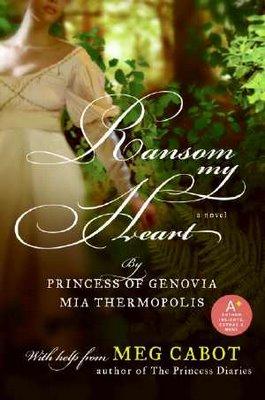
Ransom My Heart by Mia Thermopolis/Meg Cabot

Meg Cabot, writer of The Princess Diaries Series, The Mediator Series, 1-800-WHERE-R-U series, All-American Girl Series, along with other chick-lit classics, returns to her historical romance roots in her standalone novel Ransom My Heart. The author of the book is listed as The Princess Diaries narrator, Mia Thermopolis and the proceeds are going to Greenpeace.

I have been a fan of Meg Cabot since my high school days — I was a big fan of The Mediator Series which she originally wrote under the name Jenny Carroll. The show Medium takes a lot of cues from The Mediator and 1-800-WHERE-R-U became the Liftime TV series Missing. The Princess Diaries is undoubtedly one of my favorite series, and I was excited to read Mia’s novel.

Meg’s characters usually have such heart and charm and cheekiness, it’s terribly easy to fall for them. However, Finnula isn’t quite as endearing a heroine as Mia or Sam or Suze. Finnula came off as the cliche tomboy turned damsel; her antics with her bow and arrow were more cartoonish than they should have been. While readers knew what Finnula did, it was difficult to figure out what was going on in her head except when she was about to jump Hugo’s bones. Finnula did have a lot of Robin Hood/goddess of the hunt Artemis-Diana cues, which were clever if you know your Greek myths.

For her knight Hugo, Meg decided to make him closer to reality than the idealized archetype of a returning Crusade soldier. He’s far from the ideal lover – promiscuous, flawed, manipulative, morally ambiguous. I also didn’t cringe when she shifted to his perspective, it didn’t sound too feminine, which a lot of writers tend to do. Kudos to Meg for doing her homework so thoroughly on this historical period. She also writes the love scenes quite well — vivid but not too-detailed. I hadn’t expected an adult novel to be tied to The Princess Diaries, nor read her adult books so I was pleasantly surprised that she wrote love scenes… Honestly, it didn’t bother me but maybe it wasn’t the best idea to tie something that sexually graphic to a teen series that was not graphic or gave the implication that it would be.

In a cliche story like this, there needed to be much more character development overall and a tighter story plot. I felt like it was mostly bouts of lust between the two lovers, rather than a multi-faceted relationship. While all the characters had very interesting back-stories, their current ones lacked any luster. Another thing that bothered me was that characters were inconsistent, which probably stems from the lack of development. Then the epilogue seemed out of place, and it could have just ended with the last chapter.

This was not Meg Cabot’s best work. I didn’t even feel like Mia would write something like this based on her character, this sounds more like it’s Tina’s forte. While easily fun for a light read (or to maintain your status of reading all things Mia), I’d say it’s easily what it is — a very typical Avon romance novel. I was expecting a bit more from the author, but some days you win some, other days you lose some. I’d say that my book choices are progressively getting better, so I’ll count this as a win.


Image Credit to: Avon Romance Blog

When Fairytales Go to Liberal Arts College


Tam Lin by Pamela Dean

Ugh, one would think I had the worst taste in books based on what I’ve been posting as my reading material… then again, is it invalidated by the fact that I know that it’s bad after reading it?

I skipped off to the library to find a new foray into the fantasy realm and Pamela Dean’s Tam Lin caught my eye. I love fairy tale retellings and couldn’t help picking it up, especially after seeing that it was a reprint with a special introduction for the reprint. Seems glamorous, doesn’t it? Well, it’s not.

I knew it was a modern retelling of the Scottish ballad when I walked into it. I knew it was about college students in the 1970s that was originally published in 1991.  (I love Something Wicked This Way Comes and have a deep nostalgia for the pre-tech days of storytelling) . What I didn’t know what that it was an English Lit GRE review guide masquerading as a teen fantasy novel.

As someone who survived the AP exams in both English Language & Composition and English Literature & Composition in high school, then masochistically went on to get a Bachelor of Arts in English Lit, even I was beating my head against the wall for all the excessive literary inside jokes and quotes from Keats (and I adore Keats). There was also an extremely excessive need to list colleges as well — Dartmouth, Grinnell, Harvard, Colgate, University of Pennsylvania, ad nauseum.

It was like the author found a box of her old college essays and decided to write a story about them ten years later. The characters sound more like English PhD students and several professors while lecturing for class, let alone undergraduate students simply hanging out during their freshman year. I have yet to meet anyone who can quote entire Romantic poems verbatim and do it roundrobin with several other folks for fun. Also, what straight twenty-something year old guy in college is willing to give up good sex because the girl he’s dating doesn’t read for leisure?

To add insult to injury, the characters were completely stale and unbelievable (if you couldn’t guess from my previous examples). It was hard to connect to Janet, who is supposed to be experiencing the emotions of moving out of her parents’ home, having her first boyfriend (and sex), and choosing her major. As someone who passed through all of those experiences fairly recently, I was disappointed that all of these situations were handled so poorly. Janet acts more like a weatherworn thirty year old than the naive eighteen year old she’s supposed to be. Instead, Dean takes time to run through a hodgepodge literary survey of Shakespeare performance, the Classics, and the Romantics.

While I understood most of the references (even Dean points out, it’s impossible for English students to have the same set of canon behind them yet continues to assault the reader with at least two per page), it becomes extremely tiring after a while. For example, “The stage was tiny, but Robin had pronounced it large enough for a sword fight, though, he said, you would not wish to try to produce something like Henry V on it, or anything whatsoever by Shaw,” (p. 250) requires the reader to know that Henry V is about war (I got lucky and saw Ethan Hawke while he was performing it at Lincoln Center) and that there are lots of long, extended sword fights throughout. The reader would also have to know that “Shaw” is a reference to “George Bernard Shaw” who enjoyed the swash-buckling defense of a woman’s honor (I think?). Again I have a degree in this and it wears me out, what teenager would know this off the top of her head? I’m all for reading ahead of your level, but this is all gibberish if you don’t know what they’re talking about. Even then it’s gibberish.

Imagine over 450 pages of this. No real action or adventure or real magical mischief. No true insight on the trials of attending college for the first time and growing up that are requisite for the Young Adult genre. There is too much distance from Janet to care about her and she doesn’t really do much of anything worth mentioning and there’s no emotional investment in any of the overly self-absorbed characters. Heck, the romantic portion is done so badly, I think a fourteen year old girl could have written something more genuine.

It isn’t until the last 40 pages that the story comes back and gets dropped on the reader. After over 300 pages of freshman year, the story breezes through to the fall of Janet’s senior year. Little of the story links up, the attempt at social commentary on birth control, abortion and Roe v. Wade that falls absolutely flat by just having her parents simply tell her that they’ll take care of a baby born out of wedlock and she doesn’t have to kill herself. Really? She doesn’t feel worry or shame or guilt (she got knocked up from what was basically a one-night stand with her roommate’s ex/her ex’s roommate). None of it works out to be clever or insightful about anything. It just happens.

I get that it’s supposed to be a college story, but does it have to read like the essay portions of an English anthology for college students?

Well, if nothing else, now you too can pass the English Lit GRE exam after looking up all the references in this book, get a PhD in English Literature, and still not figure out how this fits into the genre of “young adult fantasy.”

(The only reason I gave this book 3 stars instead of 2 stars was because I liked how the story cleverly used The Revenger’s Tragedy and Keats.)

Lots of Evil, Not Enough Editing…


Evil Genius by Catherine Jinks

Finally I went to the library last week, and managed to express some self control when choosing books. Instead of my usual dozen, I only checked out five (that’s a new record for me). For some reason, most (if not all) of the good sci-fi and fantasy books come from the teen section. Lots of people who don’t know me say I still look (and sometimes talk) like a teen, so perhaps that’s why no one bats an eyelash when I’m circling the teen shelves like a hawk.

Anyway, one of the books I got this time was Catherine Jinks’ novel, Evil Genius. The main character was the evil boy genius, Cadel, and his twisted spiral into becoming a true villain — a tragic hero.

Trudging through chapter after chapter, I waited for the book to pick up momentum. Sure there were some interesting twists and gory yet creative deaths along the way, but overall the book reminded me of prose that needed an editor. The story was terribly inflated with too many subplots and while it builds on the larger concept of what makes someone evil, it never achieves of showing “evil” as anything more than self-inflicted by poor choices. The entire book presents itself as people always choosing to cheat, lie or steal and based on that they can easily be manipulated.

Boiling down all human motivation to “people have no self control” is absolutely ridiculous. This book was pretty much a waste of time to read and felt like something I could have easily read on FictionPress or some other free writing site.

Holding out for a Heroine

We once again circle back to the lack of strong female characters in today’s day and age. While I’d say the U.S. is still far more advanced than most countries in that it is even willing to have a discussion about female empowerment, it’s still got a long way to go.

NY Times writer Peggy Orenstein decided to tackle the issue with her daughter getting bored by princesses waiting to be rescued. There’s a song from a Disney movie that seems oddly appropriate titled “Cinderella.” There was one princess cartoon movie, not from Disney, titled Anastasia, where the girl did save herself and the guy too. It’s one of my all time favorites from my childhood.

Girls rarely get the chance to play the hero. The hero’s girlfriend (Sue Storm), the hero’s archnemesis (Catwoman), or just his sidekick (Supergirl). Orenstein quickly recognizes that most female heroines are just eye-candy molded for boys and that its an unfortunate thing she and her daughter must settle for. Female heroines often find themselves in conflict with their femininity. Often donning revealing costumes, they are one of the few outlets for young girls who are sick of waiting for Prince Charming to save them. I won’t go into the body types of female characters because really, how is that less biased than the male form depicted in fiction? Both are beautifully fit and flexible, with form-fitting costumes that leave little to the imagination.

I read a debate recently about the Power Rangers not having a female leader, and the one time they did, it was an interim period between when their original leader (also the female’s boyfriend) died and the next one was to take his place.

Why aren’t heroines unable to escape this cycle? Well, most cartoon artists are male for one thing. The American comic book nation is male-oriented, so they won’t waste R&D with marketing dollars for a niche like this. A lot of things are catered to men, more so than women. It’s okay for girls to look up to men or be tomboy-ish, but the minute the tables get turned, people get mighty sensitive.

For those TV watchers out there from the early 2000s, you’ll remember the “girl power” phase that swept the nation. Joss Whedon’s Buffy the Vampire Slayer became the beacon of this idea and the girl hero for the 21st century. The task of keeping humanity safe was left in the hands of a girl, and one that played by her own rules no less. Another show that comes to mind was James Cameron’s short-lived Dark Angel series, which too featured a street smart, genetically empowered teenaged girl who was the hero with not one, but two hot male sidekicks.

In the literary world was where I found refuge as a young girl anxiously looking for that slick, smart heroine I knew had to exist somewhere. Garth Nix’s Abhorsen Trilogy was great, with two female leads who carried on with unsure steps but a ton of heart. If you browse through any young adult section in the bookstore or the library, you’ll quickly notice that a majority of the books are female oriented — girls in mythical kingdoms who have to save it, sword-wielding smart alecs, princesses who have to save princes, girls with superpowers from other planets… The list goes on.

I won’t make many bones about it, most people don’t like to read these days and so a lot of things go uncensored. That is where the female heroine has been relegated to, the underground, between the lines world of novels and what is sometimes known as “chick lit.” Good heroines do exist, but their PR sucks. If Harry Potter were a girl, it is highly doubtful it would have reached the proportions it has today. Author J. K. Rowling had to take the nom de plume “J. K.” instead of “Joanne” because publishers feared boys wouldn’t read books written by a woman.

Society has yet to embrace the notion of a popular, individual heroine with mass appeal. Until that happens, girls are stuck just reading about great heroines rather than seeing them in action.

Image Credit to: Fanpop

Adapt This!

So I believe that the adaptation of any book into a TV series or movie is the bastardization (is that a real word? if not, it should be) of the source material (see Roswell vs. Roswell High, True Blood vs. The Southern Vampire, the Harry Potter films vs. the books, Legend of the Seeker vs. The Sword of Truth, etc.). The movie/show never lives up to the intensity and creativity of its source material, but is watered down and re-shaped for its new, blander media venue (there’s way more censorship for movies and TV than there are for books). Still, there’s always that urge to see your favorite characters light up the screen and become open to a wider audience. Here’s my list of books I’d like to see get dragged through the Hollywood mud:


The Abhorsen Trilogy by Garth Nix — (Movie) I’m a big Garth Nix fan, his stories are very visual and it would be a wonder to watch the characters brought to life. There are only 3 books in the series, so it would be a great movie set to have. Set in one a fairy tale-esque kingdom, it revolves around the daughters of an Abhorsen (necromancer) who fight the forces of darkness that threaten to destroy their world using the tools he and the generations before have left behind. While the stories feature female leads and anthromorphic wise-cracking spirit guides, I’d think this would be a great juxtaposition to the vampire trend. Zombies, betrayal and lots of action I don’t see how this wouldn’t be a smash hit at theaters. (As much as I don’t like Twilight, I am grateful that it’s made the way easier for marketing sci-fi/fantasy which is a small but devoted niche market.)

______________________________________________________

The Midnighters by Scott Westerfeld — (TV series) Another author I’m a big fan of, there was already talk about making the books into a TV show. I’m partial to agreeing with Westerfeld, Kern diminished the quality of the Charmed series when he took it over. But I’d still like to see what a world in blue without wind would look like. The series follows four friends who were born at midnight and have access to the mysterious 25th hour of the day where creatures from long ago reside, biding their time in the hopes of reclaiming the world. During the 25th hour, each of the friends has a unique power that they use to out maneuver their enemies. Though I doubt that a TV series will do justice to the ideas of child neglect and abuse (because if we don’t see it, it doesn’t happen, right?), I still hope to see this series on the small screen.

______________________________________________________

The Named Trilogy by Marianne Curley — (TV series) The story traces an ancient prophecy that foretells a universal battle royale for a group of time-travelers and the Queen of Chaos. A mix of sci-fi and fantasy, the series had tons of twists, betrayals, questionable alliances galore, along with ambitious yet flawed characters who safeguard the flow of history in order from those who seek to bend it to suit their own will. Though set in Australia, it wouldn’t be difficult to switch to American back-drops.

Lord Byron vs. Don Juan

Once more perusing Slate.com when I stumbled across this gem, Lord Byron’s Great Insight and it brought me back to my British literature course on the Romantic period. The article itself looks exactly like the mini-biographical excerpt from my anthology and only summarizes what is pretty much considered common knowledge for anyone who would ever care to know more about Byron. I have more information scribbled on two pages of an old notebook about his life than what the writer offers to us. But that is by far not the most grievous thing about the article. No, that award goes to the supposition that Byron understood knew what women wanted.

Don’t get me wrong, Lord Byron is one of my favorite poets, just like I enjoy Nietzsche’s philosophy. But that does not stop them from being complete lunatics and incestuous, misogynistic pigs. Lord Byron just knew what women wanted to hear and used it to his advantage. He was a selfish and manipulative scumbag who showed no remorse for his actions. As one of the commentators put it, reviewing Byron’s homosexual pinings and the way it caused him to lash out at his female consorts in an effort to assert his masculinity. Of course, there are also plenty of closeted gay men who don’t resort to the kind of extreme behavior Byron did. We should try to steer clear of generalizations though.

An actual review of what the book provided as a new angle or information on Lord Byron would have actually made sense rather than positing some childish notion based on one man’s promiscuous outings.

Image Credit to Limite Magazine

And the Fangs Come Out

While doing my daily perusing of Slate.com I decided to stumble on over to Double X, the “female” off-shoot of the popular online magazine. I found yet another article raving at the anti-feminism of the rebooted vampire genre focusing on Twilight and True Blood. Being the sci-fi/fantasy geek that I am, it is eye-rolling when someone not into the genre attempts to combat the forces of misogyny. The writer couldn’t seem to make up her mind about True Blood‘s stand on the vampire misogyny, but Twilight was clearly hardcore Mormon. The two works are then held against the vampire feminist icon of the 90s, Buffy. I too have ranted that Bella is the absolute anti-Buffy, and nearly choked on my coffee when a commenter called Bella a “strong female character.” Yes, my strict, traditional parents taught me that tripping over myself and crying for someone to come and save me was a hallmark of a strong person… (Actually, it was more like ‘Get your ass off the ground and give back twice what you got.’)

Buffy and Twilight are easy to compare because they’re both in the teenage fare. They share the girl loves vampire scenario common to this subsect of the vampire genre. The major difference is that Buffy slays vampires and demonstrates that even if you love someone, bending to their will is not in your best interest. Buffy made her own rules, not only feuding with the Watchers but coming back from the dead. Bella on the other hand is subject to the whims of the vampire she’s in love with and waits for him to come and save her. Twilight‘s mores make me cringe, and I come from a marriage based, wife cooks and cleans and raises the kids ethnic background. Bella just lives to pleasure Edward, and has childish fits when he leaves her. She doesn’t fight or assert herself. At least keep some garlic handy if your boyfriend needs help (or wants to suck all of your blood out)!

True Blood/The Southern Vampire books should be set apart in 1) they are adult fare and 2) it’s less along the lines of female/male dynamic than it is a sort of satire of minority vs. majority. I’ll admit I’m not a big fan of the characters, but it’s this intrinsic difference of what vampirism stands for that puts it away from Buffy and Twilight, more towards Anne Rice’s vampires and social commentary.

Now here’s where I take offense. The idea that the vampire subjugation fantasies are “bad for women.” The title is too provacative for a fluff piece that was featured. While I would like nothing better than to Fahrenheit 451 all of Stephanie Meyer’s works (which are cheap knock offs of actually good books), I wouldn’t go so far as to start calling them “bad for women” (bad for literature and a butchery of the English language, by all means yes). I tend to leave people and their sexual fantasies alone. To say these books are “bad for women” is crossing into the territory of “violence in music, TV, movies and video games caused Columbine.”

I will now refer back to the Aristotle’s idea of “catharsis.” Unlike Plato who thought that everything should be publicly censored (please tell me they haven’t swapped out Republic for Twilight just yet), Aristotle believed that exposure to our darker natures through entertainment would sate our need to act on them. In other words, we get off on seeing someone being shot rather than getting off on actually being Deerhunter ourselves. Slasher movies are a big part of American movie fare, but how often do we hear in the news that someone took a hacksaw and went on a killing spree? Some of the people who I’ve found enjoy reading Twilight novels are actually really assertive women. I just chalk the subjugation up to another kink fetish, like feet. Not really that harmful until it moves into reality.

I abhor the model of waiting for a guy coming in to save the day rather than saving yourself, and the free fall of “girl power” in the late 90s to the “lying, cheating backstabbing best friends” business that we’re currently in is a altogether disconcerting. But all in all, it’s just a phase that one can only hope passes quickly before it really does set the feminist movement back. If you want to be that tough chick who gets the job done, you’ll find a way. If you’re that girl who drops her keys to bend over so you can catch a guy’s attention and wallet, you too will find a way. There isn’t just one female archetype running around. I’d say the scary part is the fans who’ve lost touch with reality and mistake the books for some kind of psychotic bible instead of enjoying it for the entertainment value it holds.

Image Credit to Fanpop.com